
Best SAT Study Schedule for Busy High School Students
Preparing for the SAT doesn't have to consume your entire life. One of the biggest misconceptions about SAT prep is that students need to study every day for months to see meaningful improvement. In reality, the most successful students follow a consistent, focused study schedule that fits alongside school, sports, music, jobs, and extracurricular activities.
At Impactful Tutoring, I've worked with students aiming for everything from modest score improvements to highly competitive college admissions. Whether your goal is to improve by 100 points or 350+ points, the key isn't simply studying more—it's studying smarter.
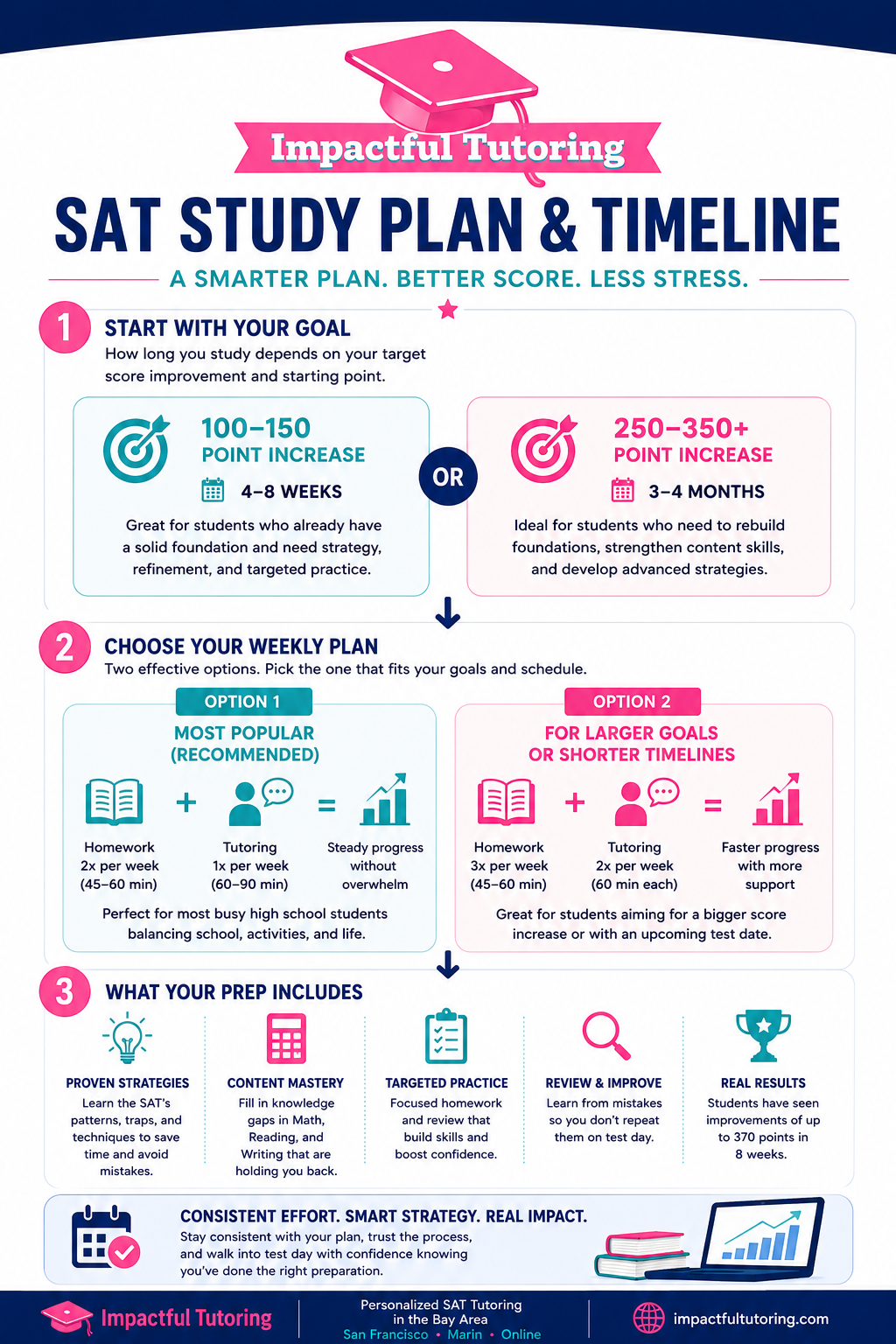
A realistic 2–4 month SAT study schedule balancing tutoring, homework, and school commitments while maximizing SAT score improvement.
How Long Should You Study for the SAT?
Most students should plan to prepare for the SAT for 2–4 months, depending on their goals and starting point. Starting early gives students time to strengthen foundational skills, take multiple practice tests, and improve without the stress of last-minute cramming.
Students Looking for a 100–150 Point Increase
If you already have a solid academic foundation, a score increase of around 100–150 points can often be achieved in 4–8 weeks with:
Consistent homework
Weekly tutoring
Strategic test-taking instruction
Targeted practice on your weakest sections
Students Looking for a 250–350+ Point Increase
Larger score improvements usually require 3–4 months of preparation.
That's because these students often need to:
Strengthen grammar and writing skills
Improve reading comprehension strategies
Learn how the SAT is designed to test students
Develop efficient pacing and confidence
The good news is that these skills can absolutely be learned with the right plan.
Every Student Needs a Different SAT Study Plan
No two students begin SAT preparation in the same place.
Some students already know the math but lose points because they rush or fall for common SAT traps.
Others need to strengthen Algebra, Geometry, Advanced Math, or grammar concepts before strategy becomes effective.
That's why personalized tutoring is so valuable. Rather than completing hundreds of random practice questions, students focus on fixing the specific weaknesses that are holding back their scores.
A Realistic Weekly SAT Study Schedule
One of the biggest mistakes students make is trying to study every day. That approach usually leads to burnout after the first couple of weeks.
Instead, I recommend building a schedule that is consistent, manageable, and sustainable over the course of two to four months.
For many students, a schedule like this works extremely well.
Option 1: The Most Popular Schedule (Recommended)
This is the schedule that works for the majority of high school students.
Two homework sessions (45–60 minutes each)
One tutoring session (60–90 minutes)
Homework reinforces the concepts and strategies introduced during tutoring, while each tutoring session focuses on reviewing mistakes, learning new content, and developing effective test-taking strategies.
This approach keeps students making steady progress without adding unnecessary stress to an already busy schedule.
Option 2: For Students Chasing Larger Score Improvements
Students pursuing a larger score increase—or preparing for a fast-approaching SAT—often benefit from a slightly more intensive schedule.
Three homework sessions (45–60 minutes each)
Two tutoring sessions (60 minutes each)
This allows students to move through more material while still maintaining a healthy balance with school, athletics, music, clubs, and family life.
Why This Schedule Works
Over the years, I've found that students improve the most when they follow a steady routine instead of trying to cram.
A tutoring session is about much more than simply solving practice problems. During our sessions we work on:
Learning the SAT's most common tricks and question patterns
Identifying the specific math, reading, or writing concepts limiting your score
Reviewing homework so mistakes become learning opportunities
Developing efficient pacing and test-day confidence
Building strategies that transfer to every practice test
Homework between sessions reinforces these skills so students continue improving without feeling overwhelmed.
What About SAT Boot Camps?
Sometimes a more intensive schedule makes sense.
If a student has only a few weeks before an official SAT or is aiming for a particularly ambitious score increase, we can temporarily increase the amount of instruction and practice. These "boot camp" schedules include additional tutoring sessions and more focused homework assignments.
However, in my experience, the balanced weekly schedule described above produces the best long-term results for most students. Students stay motivated, avoid burnout, and are much more likely to stick with the plan over the two to four months needed to achieve meaningful score improvements.
What Kind of Score Improvement Is Possible?
Every student is different, so no tutor can honestly guarantee a specific score increase.
That said, I've seen some remarkable improvements.
Some of my students have increased their SAT scores by as much as 370 points in just eight weeks through consistent tutoring, targeted homework, and focused preparation.
More commonly, students who commit to the process for about eight weeks see improvements of around 180 points, although results vary depending on their starting score, attendance, effort, and study habits.
The biggest factor isn't natural talent, it's following a structured plan and staying consistent. While this article focuses on the SAT, many of these study principles also apply to ACT preparation.
Final Thoughts
The best SAT study schedule isn't the one with the most hours.
It's the one you can realistically follow week after week.
A consistent routine of targeted homework, personalized instruction, and strategic practice almost always outperforms last-minute cramming. Whether you're trying to qualify for scholarships, improve college admissions opportunities, or simply reach your personal best, having the right plan makes all the difference.
Ready to Reach Your SAT Goal?
Whether you're aiming to improve by 150 points or 350+, the right study plan can make all the difference.
The most successful students aren't necessarily the ones who study the most—they're the ones who follow a consistent plan, focus on the right skills, and receive feedback that helps them improve each week.
I work with students throughout San Francisco, Marin, and online to create personalized SAT study plans that fit busy schedules while maximizing score improvement.
If you'd like help building a study plan that's tailored to your goals, I'd be happy to help.
-
Most students benefit from 3–5 hours per week spread across homework and tutoring. Consistency is more important than marathon study sessions.
-
Yes. Many students can improve significantly in 8 weeks, especially if they already have strong academic foundations and follow a structured study plan.
-
Not usually. Most students achieve better results with 2–3 homework sessions and one or two tutoring sessions per week, which is easier to sustain over several months.
-
Yes. While results vary, personalized tutoring helps students identify knowledge gaps, learn effective test-taking strategies, and avoid common mistakes that hold scores back.